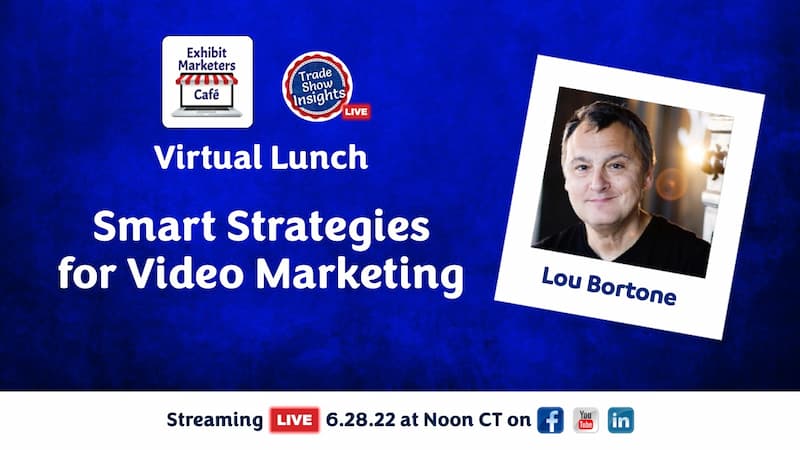
The results are in … video is the champion of online content, and you better get in the game.
But how do you create videos that get watched, shared, and remembered?
Get advice from an expert!
Now I don’t profess to be an expert when it comes to video. So I invited my friend, Lou Bortone, to be our guest on Virtual Lunch. Lou is a former executive at E! Entertainment Television as well as an online video guru. In this rebroadcast he shares helpful tips you can put to use before, during and after your trade shows and events – as well as in your everyday marketing. Learn how to:
- Craft a story that connects with your audience
- Create personalized videos
- Discover the right types of video for your goals
Here are the links to resources mentioned during the interview:
- Loom
- SendSpark
- Warm Welcome
- StreamYard
- VideoAsk
- Memento
- Request Lou’s free list of 99 Video Ideas
- Here’s where you can watch the entire Virtual Lunch broadcast
(Note: Some links on this page are affiliate links, which means if you click on them and choose to purchase I may receive a small commission or other compensation. You will not pay more for buying a product through these links. I’m disclosing this in accordance with FTC regulations regarding endorsements.)
If you still want more, here are a few previous posts from Trade Show Insights to get your creative juices flowing:
- 8 Ways to Use Video to Market Trade Shows
- Tapping Into User-Generated Content for Promotions
- 15+ Essential Video Tools for Trade Show Marketing (with some of my favorite equipment & software)
About Lou Bortone

Lou Bortone has been a pioneer and thought leader in the online video space since the launch of YouTube in 2005. He’s helped thousands of entrepreneurs and companies create and leverage online video to build their brands and dramatically grow their revenues.
Prior to his industry leading work in online video marketing, Lou spent over 20 years as a marketing executive in the television and entertainment industries, including stints as National Promotion Manager for E! Entertainment Television and Senior Vice President of Marketing for Fox Family Worldwide in Los Angeles. Lou is a popular speaker, author, and ghostwriter of six business books. He’s also the author of “Video Marketing Rules: How to Win in a World Gone Video.”
Marlys Arnold [00:00:00]: You're listening to the Trade Show Insights podcast, season 17, episode six. I'm your host and exhibit marketing strategist Marlys Arnold, bringing you tools to improve your exhibit results. On today's episode, brought to you by the Exhibit Marketers Cafe. We've got tips, tips and tools to help you improve your video marketing strategy for your upcoming trade shows and events. Lou Bortone has been a pioneer and thought leader in the online video space since the launch of YouTube in 2005. He's helped thousands of entrepreneurs and companies create and leverage online video to build their brands and dramatically grow their revenues. Prior to his industry leading work in online video marketing, Lou spent over 20 years as a marketing executive in the television and entertainment industries and including stints as national promotion manager for E. Entertainment Television and senior vice president of marketing for Fox Family Worldwide in Los Angeles.
Marlys Arnold [00:01:38]: Lou's a popular speaker, author and ghostwriter of six business books. He's also the author of Video Marketing Rules, how to Win in a World Gone Video. So, Lou, welcome so much to Virtual Lunch.
Lou Bortone [00:01:51]: Thank you so much. And by the way, I have gum with vitamins.
Marlys Arnold [00:01:59]: Well, you're on a leading trend, Lou.
Lou Bortone [00:02:01]: I guess so.
Marlys Arnold [00:02:03]: For anybody who happens to be listening to this on the podcast and not seeing the first part of the video, you'll have to go check out the full version to get what the gum with vitamins is all about.
Lou Bortone [00:02:14]: Right.
Marlys Arnold [00:02:15]: Well, Lou, thank you so much for being here. I know you are, you are my video guru. You are who I look to for what's new and what's coming and, and you know how to do things. So let's start out a little bit, talk about how, how do you create more compelling video? I mean, because we all know video marketing is where things are going. I mean, that's what Google and all the search engines are, you know, prioritizing video. How can we be better about creating video that actually works?
Lou Bortone [00:02:46]: I guess, yeah, there a few ways and probably the, the main thing is to think about it in terms of storytelling, you know, telling a story. Because even a 15 second video can be a quick little story with a beginning, middle and end. So you want to engage folks by, you know, basically turning, you know, not just a promo, but kind of turn it into a story or make it more personal and engaging. Another way to really just make it more compelling is to make sure that you know exactly what you want the viewer to do at the end of the video. So really kind of reverse engineer the video. What's the goal of the video and how Are you going to get the viewer to do what you want them to do? And that could be come to an event or get on my calendar or download a freebie, whatever it may be. You want to say, what do I want the viewer to do? And then how do I get them to do that?
Marlys Arnold [00:03:39]: That's a really good point because I think a lot of times we have a tendency to just create this really cool video and we forget that there has to be a point to it at the end. Not just that, you know, not that the entertainment alone isn't bad, but you know, when it's a business marketing video, you've got to have, you got to be leading people somewhere. So let's talk a little bit. And I know you are no stranger to trade shows. You've spent your time on the trade show floor. So what are some ideas you have for, you know, pre at and post show? I mean, because there's ways to use video in all three.
Lou Bortone [00:04:14]: Oh yes, absolutely.
Marlys Arnold [00:04:15]: Stages.
Lou Bortone [00:04:16]: Yeah. And back back in the day, you know, when I was at E and various companies in la, it was all about who had the biggest video screen or video monitor or video wall. But these days it's really more about, you know, not so much mass marketing as personalized marketing and personalized video. So I would say, you know, especially with the exhibit business, but really across any industry, the more you can engage one on one with folks, the better off you'll be. So I do it sort of a combination of like, okay, well here's the mass market video and here's what we put on YouTube and Facebook. But at the time you can also do videos. And what I like to do when I go to events or trade shows is if there are specific people who I want to connect with or specific people I want to meet, I may send them a video email before the show. So I'll use loom or send Spark or Warm welcome.
Lou Bortone [00:05:10]: It's a whole bunch of really affordable video email tools to send them a personal message. And that way they're already sort of like, oh yeah, you're the guy that sent me the video. That was really cool. And obviously at the event you can connect with them, maybe get them on a video and do a quick testimonial or quick, hey, we're both here together. So sort of a video selfie. So you kind of have a record of having been with them. And then after the show, same thing with follow up, hey, it was great to meet you at the show. Not just an email, like, okay, if I come Back with a pile of business cards.
Lou Bortone [00:05:42]: I'm not just gonna put them in my database and blast email them. I'm gonna take each one individually and do a personal video message. And really it takes like 20, 30 seconds, so I may do 10 of those in half an hour. And now I've made personal outreach with video.
Marlys Arnold [00:05:59]: Yeah, I love that idea. I actually have sensepark as well. I, I don't use it as much as I probably should, but it is really cool. And the great thing about it is, like you said, you can personalize it just for that person. And then I don't know with all of them, but at least with that one, there's actually a button where they can click to send back a video reply to you. And that's been really cool.
Lou Bortone [00:06:21]: That's. I've been able to get a lot of conversations going. And that's the whole thing is, you know, kind of get that conversation going and engage them outside the show. And the nice thing about tools like that is they can reply not only in video, but they can also reply via text or audio. So whatever they're most comfortable with, they basically get back to you and then, you know, do a whole back and forth. And I've gotten personal one on one clients that way just because people will say, oh my gosh, of all the folks I met at the show, you're the only one that actually sent me an email. A video email.
Marlys Arnold [00:06:53]: Well, yeah, I'm sure there's not that much be, you know, it's not being used that much already, so it is a good way to stand out. So also, as far as doing a pre show, you know, you come from the, the movie and entertainment world. So I'm thinking like, you know, the pre show could definitely be kind of correlated to the idea of a movie trailer. Have you seen anybody do some really great ideas along that line?
Lou Bortone [00:07:20]: It's really a matter of sort of, you know, what's the hook and how do you kind of get them engaged and interested and to sort of create a curiosity gap like, oh my God, when I go to the show, I have to visit the such and such booth because I heard they were going to do blah, blah, blah. So you're sort of creating pre industry buzz. Way, way, way long ago when I worked at E. Somehow we got, and I don't really know. Well, I guess E. Hollywood, we got the actual Batmobile at the booth. So we were sending out all these little, this was sort of pre video, but we're sending all these little kind of things. Like, oh, you come by and see what we've got coming to visit the Batcave.
Lou Bortone [00:07:56]: So we made the whole booth a bat cave and the Batmobile was sort of the showcase piece of it.
Marlys Arnold [00:08:00]: Oh, too funny.
Lou Bortone [00:08:03]: So whatever you can do to bring your booth or that experiential piece to life before, during, after is really the best way to do it.
Marlys Arnold [00:08:14]: Well. And so talk about, because it's not like you mentioned earlier, that you can do a really great video in 15 seconds. So it's not always about doing, doing these big elaborate Hollywood style productions. Sometimes it is the little short, snackable videos. So how do, how do you know what kind of video is appropriate for what? Or should you always do a mix or how do you, how do you figure that out?
Lou Bortone [00:08:38]: It really depends on the audience and some of it is demographics. I mean, I used to say, oh, Tick Tock's just for kids. I'm not going to fool around with that. But it's gotten so big and it has a billion users that you can't really ignore it. So you want to find out, you know, what are your audience's preferred platforms? And there are certain ones that sort of like, well, you can't go wrong with YouTube. It seems like everybody's there.
Marlys Arnold [00:09:00]: Right.
Lou Bortone [00:09:00]: But whether or not you're going to use, you know, Instagram versus TikTok versus LinkedIn really depends on your audience. And speaking of LinkedIn, I think it's a really underutilized platform when it comes to video.
Marlys Arnold [00:09:15]: I agree, I agree. And it's, I think it's interesting because one thing I have noticed is LinkedIn is actually, well, Twitter as well, I guess. But they're about the only platforms that don't mind you linking out to something else. So it doesn't even have to be, it doesn't have to be a video that you upload straight to LinkedIn. You can link out to a YouTube video and they're still okay with that. So, you know, that's one thing I've learned is it doesn't always like, as opposed to Facebook, you always have to upload the video straight there because you put a YouTube link, they won't share it.
Lou Bortone [00:09:49]: Yeah. And as you know, you know, with LinkedIn, well, with anything, you know, like with the platform that we're using here, Streamyard, you can go live to LinkedIn, Facebook, YouTube, etc. Simultaneously. So you have a better chance of reaching your audience.
Marlys Arnold [00:10:02]: Exactly. Yeah. And that's, that's one thing I love about Streamyard is, you know, we're streaming in Facebook, LinkedIn and YouTube all at the same time. So talk about, we, we talked a lot about some strategies and some things that you could do. What are some of the mistakes that you see people doing with their, I mean, I know there's a long list, but what are some of the, the video things that people, you know, maybe, maybe they're doing just because they don't realize that they shouldn't be doing it that way.
Lou Bortone [00:10:31]: Right. Well, the first mistake is just not doing it at all or thinking that it's too complicated. So. And the other mistake is, you know, not being afraid to make mistakes because with technology they' always going to be, you know, a few glitches here and there, but people are pretty understanding about that. But I think the, the mistake is like looking and saying like, oh, this is the way, this is the one way to do video, you know, and that's not the case. I mean, really, it has as much flexibility as your imagination allows. So knowing that there's more than one way to create video, whether it's short video or mobile video or, you know, vertical video, like what's on TikTok, just knowing that there are tons of ways to do videos, you don't have to get sort of pigeonholed into one style. And if you try different styles, you'll find what I call your video sweet spot.
Lou Bortone [00:11:21]: Like, okay, this is a good platform for me and my audience. And when you find that intersection of like, okay, I like doing this and my audience likes seeing it, then that's sort of the, your fallback video style.
Marlys Arnold [00:11:35]: Well, and you've done a lot of really fun videos over the years. Let's see, you've been the Godfather, you've been Moses, I believe.
Lou Bortone [00:11:46]: Well, that's the other thing that's, you know, a mistake is like, again, thinking, and originally when I started doing video, I'm like, okay, this is video. I have to be serious. And then my friends are kind of like, you know, you're a total goofball. Why don't you just goof around? So when I started to inject some of my personality and not be afraid to, you know, sort of make a fool of myself, that's when things kind of clicked. So you have to just, you know, be able to put your personality into it, have a little fun with it. And you know, like I tell folks, it's only video. I mean, it's not like, you know, we're going for open heart surgery or something.
Marlys Arnold [00:12:18]: Well, and like you said, if you're doing just these quick little Shorts. It's like, it's a lot easier to do something fun with that than it is, you know, if you, if you know you're doing something that's more like long lasting or more, I think you call it pillar content, you know, the really solid content, you know, then yes, you need it to look different. But yeah, just doing quick little social media videos. Why not have some fun with it? Back to we were talking earlier, the Savannah Bananas, I mean obviously they have a ton of fun with their events and their videos. So.
Lou Bortone [00:12:50]: Yeah, and that's the other distinction that I like to make that you sort of alluded to, which is you, if you're doing a quick video or if you're doing a keeper video. So quick video, okay, I'm just going to do this quickie on my iPhone or I'm just going to do something for TikTok or something really relatively quick and simple. I won't say disposable, but just quick, fun, easy. Keep a video like, okay, we're going to put a new video, excuse me, on my homepage. So we need to put some thought into this. This is going to have some shelf life. This is going to be an evergreen video. So those keeper videos you want to put some more thought and work into.
Marlys Arnold [00:13:29]: Definitely. And maybe a little higher production value as well in those rather than the quickies. So give us some more ideas. And I know you've got a list of 99 video ideas, but what are you thinking, especially from the trade show framework, what are some ideas that you want to share of video types?
Lou Bortone [00:13:51]: Oh my gosh, there's so many different ways to do it. I mean obviously the quick short form video like TikTok or Instagram or now YouTube has YouTube shorts. These tend to be, you know, 30 to 60 second videos that you could just do kind of on the fly. So anytime you have an idea or you have a thought or like I just did one this morning to my folks saying, hey, I, you know, it's the, at the time we're recording this, it's the first half of the year is over, let's start to plan the second half. So when my friend comes over, I'm going to sit down and do a football background and do a halftime, sort of like football analysis kind of thingy. So just, you know, have fun with it and whenever you want to, you know, whenever you get an idea, just jump in and do it because you know, videos sort of become low hanging food. It's not difficult to do. You've got zoom, you've got things like Streamyard, you've got your, your phone.
Lou Bortone [00:14:46]: So it doesn't require, you know, a lot of pre production to kind of jump in and just do the video. And the other thing is that, you know, people often say, well, I'm not sure what to talk about. And then again with that like 99 video ideas, just like, okay, talk about a lesson the mentor taught you or talk about your favorite quote or talk about your favorite movie or why you liked or didn't like Top Gun sequels, things like that. So I try to also look at the news and pop culture and what's happening that's not too depressing and talk about that.
Marlys Arnold [00:15:19]: Well, and like on the show floor, one thing that I always try to do and like you said, it's much easier now that we all carry a camera in our pockets. But you know, walking the show floor and just filming different exhibits and doing kind of a recap of different things, kind of like, you know, we shared about the food that was innovated at some of the recent shows. And so, you know, just walking around and kind of doing, kind of being a news reporter and sharing those little recaps. And I know Mel's here from Classic exhibits. Kevin, his cohort at Classic did a walk around tour at a show last year and that was really helpful to me. Able, you know, if you can't attend in person, it's great to be able to see it from somebody else's eyes of like actually literally walking the show floor and seeing how things look and how many people are there and that kind of thing.
Lou Bortone [00:16:09]: So that's a great idea too because there may be, you know, in the days of COVID people who can't or don't want to attend live. So if you just grab your phone and say, okay, you know, me and Chuck are going to go around and find who has the best food at the, you know, which booth has the, the best, almost unique food and just kind of going around and having fun with it. And so stuff like that, just, you know, whatever pops into your head, don't be afraid to try it.
Marlys Arnold [00:16:40]: Yeah, exactly. I think that's, I think that sometimes is what holds people back is because they are thinking that, oh, I have to do something really professional or really, you know, really Hollywood style or something and they, they forget that it's okay to just, just experiment. Like you said, some videos can be what you call it, disposable.
Lou Bortone [00:17:03]: Yeah, yeah. And not everything's going to work, but that's okay because, you know, there Are things like, oh, I'm going to do such and such and people are going to love it and it just falls flat. It's like, well, you know, I gave it a shot and the next one will probably be better.
Marlys Arnold [00:17:16]: Yeah, yeah, that's true. Well, any other really cool tools or things, you know, tidbits that you want to share with us as far as making our trade show videos better?
Lou Bortone [00:17:27]: Right. Well, you know, obviously we talked a little bit about Loom, which is a very simple video email device. Anything where you can kind of capture that on the fly. There are a lot of things coming out now where it makes it very simple to get testimonials like Video ask and things like that. Because I know sometimes folks are hesitant to do testimonials, but the show floor is such a great place to find somebody that you don't see that often and, and pull them aside for a quick testimonial. So things like Video Ask even send spark and warm welcome. You can do your, your video testimonials that way.
Marlys Arnold [00:18:08]: Yeah, like you said, there's new tools popping up all the time. It seems like it just endless video tools and video creation ideas. So I want another one called.
Lou Bortone [00:18:18]: Oh, I'm sorry, I was just gonna pop in with the one.
Marlys Arnold [00:18:20]: Oh, no, that's okay. Go ahead.
Lou Bortone [00:18:22]: Another video tool called Momento. Momento app.Momento.com and I like that one because it will collect video testimonials for you or just videos in general. Like we did a big. Somebody who had been ill, we did a big happy birthday and we got like seven or eight different people and it creates the montage for them. So you're sending somebody not just one video or testimonial, but like, oh my God, here's 10 people all singing Happy birthday to me.
Marlys Arnold [00:18:53]: That is awesome. I have not heard of that one yet. I'll have to go check that one out. So. Well, like I shared earlier, Lou is a never ending source of great ideas and great resources. So if you want to connect with him, his address is Lou Bortone.com and you have that 99.
Lou Bortone [00:19:13]: Right.
Marlys Arnold [00:19:14]: Listen, 99 videos. Yeah.
Lou Bortone [00:19:16]: Yep. So if you're looking for ideas or what to talk about on your next video, you can just go to Loubortone.com 9999. Cool. Yeah.
Marlys Arnold [00:19:26]: And Silvana says she really likes the idea of a video ask. Yeah, the video testimonials. I think that's a really great idea.
Lou Bortone [00:19:34]: Yeah. And it's one of the things that, you know, I have to keep reminding myself like, oh my God, it's social proof is so important. And if you are getting a video testimonial, even if it's just a quick 22nd something or other, those are really powerful as social proof.
Marlys Arnold [00:19:50]: And like you said, what better place to do that than on the trade show floor where everybody's already there. You don't have to. You don't have to chase them down. So exactly. Lou, thank you so much for being here with us for Virtual Lunch. I think you've given us a ton of ideas to try, and I'll be anxious to see what everybody uses and start sharing in social media for their next trade show. You can find all the links mentioned during our interview in this episode's show notes@tradeshowinsights.com and if you'd like to join us for an upcoming Virtual Lunch, you'll find info on that at exhibitmarketerscafe.com/lunch. If you enjoyed today's episode and would like more, you can subscribe to the podcast and automatically receive future episodes on your chosen device. Simply search for Trade Show Insights in Apple, Spotify, Stitcher, or virtually anywhere else that podcasts are found, then click the subscribe button.
Marlys Arnold [00:21:07]: Trade Show Insights is protected by the Creative Commons Copyright License. You may feel free to share this recording with colleagues or embed it on your own blog, as long as it's shared in its entirety and is not used for commercial purposes. To learn more, please see the link in the sidebar of the show notes at tradeshowinsights.com. Well, that's it for this episode of Trade Show Insights. Be sure to check out our Show Notes and archives at tradeshowinsights.com. You can also connect with me using the social media links or the contact page on the site. I'm Marlys Arnold. Thanks for listening and be sure to join us next time for more tools to improve your exhibit results.
Sign up to receive email updates
Enter your name and email address below and I'll send you periodic updates about the podcast.