
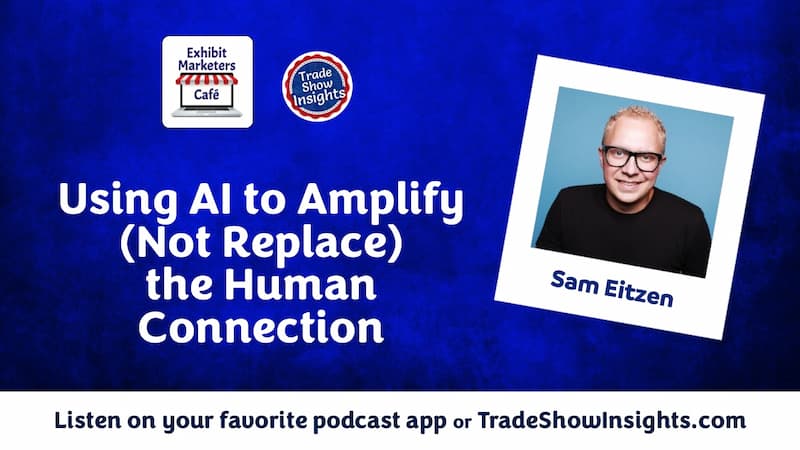
Are you intrigued and excited by the rapidly-evolving world of AI?
Or does it leave you feeling cautious and overwhelmed?
If you’re like most event professionals, it’s probably a combination of both.
So I invited Sam Eitzen, CEO and co-founder of Snapbar, to discuss the latest trends shaping event tech and why authentic attendee experiences are more important than ever.
Listen as we share ways to future-proof your trade shows and elevate human engagement with:
- Exciting ways AI is changing live events and trade shows
- Less obvious and advanced AI strategies for engaging attendees
- Tips to ensure events feel authentic and foster genuine human connection
- One big trend event professionals should be paying attention to right now
Here are the links to resources mentioned in the interview:
- Snapbar – photo & video activations that engage attendees
- Connect with Sam on LinkedIn
Sam recommends these AI tools:
- Wispr Flow (for AI dictation to write emails from my treadmill!)
- Claude (my fave out of all of the core models)
- N8N (for deep automation using AI models)
- Fireflies or Gemini (AI note-taking for meetings)
Marlys recommends these AI tools:
- Castmagic (my favorite tool to create transcripts & repurpose content into social media posts, clips & more)
- Straico (sadly this platform no longer exists)
- SuperCopy.AI (use to create custom audience personas & content tailored for each of them)
- VocableAI (create 30 days of content with just one prompt: blog posts, video scripts, carousels, & more – use the coupon TRADESHOW for a 20% discount off your 1st month)
(In the spirit of full disclosure, some of the products mentioned on this page are my affiliate links, which means if you click on them to purchase I may receive a small commission or other compensation. Thanks! ~ Marlys)
About Sam Eitzen
Sam Eitzen is the CEO and co-founder of Snapbar, the experiential marketing platform that helps brands and agencies turn engagement into measurable results.
Since bootstrapping the company with his brother in 2012, he’s navigated through multiple industry pivots: from photo booth rentals to AI-powered experiences now used for event and marketing activations around the world.
Sam is passionate about the intersection of technology and human connection, and how the events industry is evolving from logistics-driven to strategy-driven. He brings a unique perspective shaped by growing up in Morocco, building a company, and the conviction that the best marketing doesn’t feel like marketing at all.
Marlys Arnold [00:00:00]: You're listening to the Trade Show Insights podcast, season 21, episode 5. I'm your host and exhibit marketing strategist Marlys Arnold, bringing you tools to improve your exhibit results on today's episode, brought to you by the Exhibit Marketers Cafe, we're talking about AI – how to use it, how it can make a difference for your events, and what to watch out for. Well, there is no doubt that AI is a hot topic these days and especially in the events world. I think a lot of people are still a little confused and hesitant and all kinds of things. So we're going to dive into that today. We're going to talk event tech, but really drill down on AI and, and my guest today is so perfectly poised to answer a lot of these questions. Today I have Sam Eitzen, who is the CEO and co founder of Snapbar, the experiential marketing platform that helps brands and agencies turn live engagement into measurable results.
Marlys Arnold [00:01:41]: Since bootstrapping the company with his brother in 2012, he's navigated through multiple industry pivots, from photo booth rentals to AI powered experiences used for event and marketing activations around the world. Sam is passionate about the intersection of technology and human connection and how the events industry is evolving from logistics driven to strategy driven. Boy, you are speaking my language, Sam. He offers a unique perspective shaped by growing up in Morocco, building a company over the past 14 years, and the conviction that the best marketing doesn't feel like marketing at all. Welcome to Trade Show Insights, Sam.
Sam Eitzen [00:02:22]: Thanks so much, Marlys. It's good to be here.
Marlys Arnold [00:02:25]: Well, let's start out because like I said, a lot of event profs are still confused or hesitant or not real sure about using AI. So just talk about or sometimes event tech in general. Let's start by talking about some of the most exciting ways that you're seeing event tech changing. Live events and trade shows.
Sam Eitzen [00:02:50]: Yeah, so event tech generally, before I just jump in into the AI specific piece, I think, well, I'm a little biased and shaped by kind of like my entry into event tech, which happened around the pandemic. And I would say that event tech became, I don't know, kind of a hot topic during that period of time because so many logistics based systems that people relied on had to kind of become technologified. That's word I made up. Right. But like, you know, like literally like our product today was born because the client said, does the thing you do in person work online? And it's like that was the big question. And at the time I had to say no. And then we built a solution that did. And right.
Sam Eitzen [00:03:33]: So, and so I was like, now, okay, now we have event tech versus like just, you know, what, what we were prior to the Pandemic, which is like a photo booth rental company. And so there's all sorts of interesting things in the world of event tech that I pay attention to. I really like our lane. And so the one that I'm most familiar with happens to be really like related to like engagement. So I follow a lot of companies that are working on different aspects of engagement. Everything from like polls and kind of human interaction in live scenarios, visualizing those metrics in real time. I follow a lot of the companies that are doing a lot of like facial recognition or scanning which then improves and speeds up registration, entrance, kind of tracking like booth or kind of trade show flow. I want to say I follow.
Sam Eitzen [00:04:21]: I mean these are the companies that are kind of in my like, you know, peripheral where, where it's just like, it's interesting to me. I, I think it's, I look at them from like a growth perspective or like an admiration perspective, thinking, oh, interesting. They took this technology that existed in all sorts of other places and industries, but they're bringing it and making it relevant to events, solving problems that didn't exist before. I'm super interested in how people are approaching networking and making networking better because I love going to events, but I'm not the most outgoing person. So I've always struggled to like do personal networking. And the old school, like you show up and grab a drink and wander around, you know, bar height tables hoping that you run into someone is like, did not work. I would honestly just avoid those. So super interested in people solving that problem.
Marlys Arnold [00:05:09]: Well, and I think too as far as networking, I think a lot of it is like, you know, even those of us who maybe are not necessarily introverted, but you know, like, I feel like I'm pretty extroverted and outgoing. But if you put me in a situation when all of a sudden I'm thrown in with like, you know, 500 strangers, well, yeah, I'm going to be a little bit more hesitant. And so I think, yeah, having some of those networking tools that can help to encourage and facilitate the networking, I think it's really exciting. I'm like you, I kind of like pay attention to all these kind of things. I mean there's no way you can really deeply follow all of these ideas. But it's really fascinating to see some of the event tech that's out there that's Helping to solve. And I think that was a key that you mentioned was looking at how you can solve a problem with the tech. Because I think too many times it's the reverse.
Marlys Arnold [00:06:02]: It's like, oh, well, this is really cool tech. And everybody's talking about it, we've got to have it at our event. And it's like, okay, what problem is it solving? Is it a problem you even have?
Sam Eitzen [00:06:12]: Yeah, no, it's true. I mean that's. Those are the companies I pay attention to. I mean, during, during the pandemic era, like a lot of platforms that grew very quickly solved the big issue that was, you know, like, how do we get people to like attend live but from home? And how do you make that interesting? And how do you get people to like chat with each other? And it's evolved from there with the growth of, or I shouldn't say the growth, but kind of like the comeback of in person and then its growth since the comeback. And I think the future is like brighter than ever for live in person events. Of course, yes sir. We all know that virtual and hybrid is so much easier now because we had that experience. But, but when everything in the world of AI is becoming harder to kind of trust in a sense, I really think that like the value of in person stuff just never stops being great and like has a very bright future.
Sam Eitzen [00:07:10]: So I love being in this industry for that reason and focusing on like the human connection pieces because I think it's valuable.
Marlys Arnold [00:07:18]: Well, let's talk a little bit about what are some of the maybe less obvious or a little bit more advanced ways that event professionals, especially as far as trade shows, could be using AI because I think too many people are still at the surface level of like, oh, I'm gonna just throw something into Claude or chat, GPT or whatever and just, you know, get this as people are calling it AI Swap, you know. But what are some more advanced strategies that, that you think that more events should be utilizing?
Sam Eitzen [00:07:52]: I mean, I first, I think if people do learn the basics, because I like to caveat, I don't want anyone to kind of like think that their use of, you know, Claude or something like that isn't good or could, you know, could be good. So if you're doing that, I think that's great. I think there's ways to use it to prompt it, to orchestrate it. That can be incredibly powerful because I still use Claude projects, Claude cowork, Claude automation all the time. But I will say, like, it kind of grew from just like, I'm in the chat to now I'm using Cowork, which has access to my like desktop and they make it remarkably easy to set that up. And then I'm using the design tool that they came out with to do to like help with like proposals and stuff like that. When I'm like talking about new concepts with various partners and I'm realizing, man, like just in this one tool I don't have to do anything crazy like set up an open claw machine or whatever. Like there's a lot more than just the basic chat.
Sam Eitzen [00:08:48]: So I think it's great when people use that and jump in. But to go beyond there, I mean what we are trying to do even as a company is not specialize in everything. So. And I'm not even talking about events right now. So like as we think about the growth of Snap Bar, it's tempting especially because we are creating a lot of code and a lot of products and a lot of content, a lot of everything with AI to think, oh man, it's just so easy to do now, relatively speaking, let's just build this ourselves. I don't want to waste my time building something myself when I can pay someone else some reasonable amount of money and they're obsessing over making solving that problem for me. And that's just like in general, like a business case. I think that translates to events, which is, it's tempting for some people to think, oh well, I've heard that AI is like going to replace all the jobs or all this stuff.
Sam Eitzen [00:09:38]: And so I think that it can do all of these different things for me or they'll be like, I could just build my own version of this. And I've seen this at events where they'll try to build their own networking solution and it just going not horribly wrong but like completely falling apart, not doing anything that it was promised to do. It's, you know, whereas, I don't know, sure, it might have cost more money
Marlys Arnold [00:10:00]: and they've spent how many hours doing that?
Sam Eitzen [00:10:02]: Exactly. It's just a total distraction. So. So I think from that perspective, if there is something that you're that an event planner, producer, experiential marketer is thinking about in the world of events that they think they could maybe do or they have an idea about, I, I really am in you know, favor of because we do this for our own business, like find the expert. So long as you get, you know, I mean obviously budget constrains everything but like if you can find someone is like an expert in this particular Thing, it's pretty powerful, like investing in a company or a vendor or a partner that makes it their job to figure out networking or to figure out photography or to figure out recording sessions, et cetera.
Marlys Arnold [00:10:46]: Yeah, well, and exactly that. Like you said, I think too many times people just go out to the name brand tools that, you know, the generic tools that everybody's familiar with, and they don't realize that there's so many specialized tools. Like one you and I were talking about right before we hopped on this call. One of my favorites I'm using for my podcast and other things is called Cast Magic. And it takes. And not only creates the transcript, but it creates pieces of content from the transcript. So I don't need to go back, you know, so. And disclaimer to people listening, you probably have seen some of these posts on LinkedIn that I've created about my podcast episodes thanks to the specialized tool that.
Marlys Arnold [00:11:29]: That's what it does. I mean, that's all it does. You know, it's not creating all these other kinds of things, but it's focused in, on repurposing content. And there's a lot of other tools out. You know, like you said, networking. You know, there are tools out there that are, that is what they were built for. And so, you know, don't. I think the biggest thing is don't get so hung up on, oh, well, there's only three tools, you know.
Sam Eitzen [00:11:53]: Yes, yes.
Marlys Arnold [00:11:54]: The generic tools that people use every day. And it's like, no, you don't have to try to make everything come out of those tools.
Sam Eitzen [00:12:01]: Yeah. Or I think it's a great point. Or buy into too much. The kind of, you know, in my opinion, dramatic LinkedIn posts that talk about someone building all of the tools themselves. I just think it's a ridiculous waste of time. It's not realistic for a lot of events. It's way too risky, honestly. Like, you can't deal with like homemade tools when you're dealing with 10,000 people at an event.
Sam Eitzen [00:12:25]: I mean, exactly. But, like, I would. No, yeah. And that's the other thing in events too is like, there is this element of like, responsibility that falls on an event planner or a producer, and that responsibility is then shared and put on vendors. And it's the reason in the world of events, once you find a really good vendor, it's hard to move away from a vendor if they are consistently delivering for you. But, you know, so, so, and I'm all for that. Like, if a vendor continues to deliver, keep using them. But that's where you kind of.
Sam Eitzen [00:12:59]: That's another potential tricky part, which is like, there are more vendors out there. And just because you've, you've used one for a few years and nothing horrible has happened, doesn't mean that you might be able to find something that's a lot better.
Marlys Arnold [00:13:10]: Exactly.
Sam Eitzen [00:13:10]: Looking around and I mean, that's. I love competition, personally, in sports. I love it in, you know, and so. And I like it in business. It's like I am motivated to create a better product when other business people are creating great products in my space. It makes me want to do better and serve our clients better.
Marlys Arnold [00:13:30]: Well, and on the flip side, because I've also learned this the hard way, is it never hurts to be familiar with more than one vendor of a particular tool because you never know when the one's going to go out of business.
Sam Eitzen [00:13:43]: That's very true. That's very true. Yeah. No, it's a very good point. Yeah. I think AI is. It's scary. There's a lot of it that's scary and there's a lot of it that's unknown.
Sam Eitzen [00:13:56]: But the more that I've kind of. And my company has gotten into how it works, trying to integrate it into our business systems learning. Oh, that didn't work as well. Okay, never mind. We're not, you know, like, we experiment and we definitely get things wrong as we try to roll AI into more and more function, to automate more, to build more. It's not all perfect, but just like any new technology or any kind of, like, learning process, you realize what works well, what, what doesn't. You adapt, you pivot, you do whatever you need to do. And we today have incredible workflows that use AI that I'm very, very grateful for.
Sam Eitzen [00:14:34]: And it's like making our work and our product genuinely better, not just faster, but, like, it's making it better, which I think is what kind of gets glossed over. Sometimes when everyone talks about efficiency, efficiency, efficiency, it just kind of people feel like, oh, it's just about a matter of speed. I don't think it's always a matter of speed. Sometimes actually, I think it produces better results, better products. Yeah, it's not just that, like, I don't know, like, you could probably learn how to edit video if you really wanted to, but some automated system trained on the right way to cut things and paste them and splice them and, and, you know, like, it genuinely might be better than however long you could spend to learn. Not just it makes it faster and avoids, you know, the process of you having to learn it. So. And I think that's a helpful way to look at it too.
Sam Eitzen [00:15:20]: Like, there are some ways that it actually improves the output.
Marlys Arnold [00:15:23]: Well, exactly. And I think too, you know, because this is something else you and I had talked about earlier is that there's always that hesitation of, you know, well, how much do I let the AI tool do and how much, you know, you've always got to have that human on the back end. You know, it should be, you know, get the. Get the raw output from the AI tool. You know, like you were talking about the video editing look it over before you actually publish it, you know.
Sam Eitzen [00:15:53]: Yeah, because, you know, it requires taste.
Marlys Arnold [00:15:56]: Yeah, well, and sometimes maybe it clipped out a really important part that you felt like needs to be there or maybe, you know, it changed something that you didn't want changed or whatever. So you always need that human editor to look over the finished product before you put it out in the world. So I think that's really important too. It's like, you know, it's so. Well, and I'm seeing this a lot, like with, especially with AI video, I've seen television commercials that are so obviously AI generated, you know, because all that you could tell the people all have that kind of sort of almost painting, but not quite almost realistic. You know, it's like they have, you know, and it's like. And they'll have the really jerky movements or something. It's like I'm like, oh, you know, so I always tell my husband, it's like, oh, well, that one was AI generated, you know, and yeah, it's like, you don't want to be putting stuff like that out there representing your brand, because you need to make sure that whatever you're generating in AI is.
Marlys Arnold [00:16:56]: I mean, it's going out there as you. So. So you've got to be the final step in the process, for sure.
Sam Eitzen [00:17:04]: I mean, a lot of people talk about AI slop generally, but if there was better curation going on and no one posted like AI Slope, no one would be talking about AI slot, because you'd never see it now. You'd still notice that something's AI versus not. But there's a massive difference between, like, yeah, a good video and a bad video. And it's up to you, the human who's clicking publish or post or whatever it is to.
Marlys Arnold [00:17:31]: To.
Sam Eitzen [00:17:31]: To determine, like, what do I care about? What do I want my audience to see? So, yeah, the. Whatever commercials you're seeing that use AI video for the for that? I mean, do they care about the perception they have with their consumers? I'm assuming. So does that consumer happen to care about like perfect, you know, AI video? Maybe, maybe not. I mean, that's where it depends. I've seen a lot of ads that use AI and almost deliberately lean into the fact that it's ridiculous. There's some big brands that have, where they've kind of like teased the fact that it's AI, in which case it's like, oh, well that's, that's taste. That's deliberate. They literally were kind of poking fun at the fact that AI was messing stuff up and were trying to create virality or like notoriety through it.
Marlys Arnold [00:18:15]: Yeah. And they're just trying to start the conversation around everything.
Sam Eitzen [00:18:17]: Exactly.
Marlys Arnold [00:18:18]: So.
Sam Eitzen [00:18:19]: So I think, yeah, I mean, any blog you publish, anything that you write, it's pretty easy to even tell in my opinion. When people write LinkedIn posts or emails with AI, I get email replies all the time that sound as if an AI wrote it. And it's like, I don't really care. But if it's really like, if I ask like a series of questions and the answers are all kind of half baked to try to like say, help get a proposal to a client, I'm like, I don't know if this is going to be the right client to work with. That's the perception I have in my mind. I don't shut that out immediately. But I'm thinking if they're not willing to like give me real answers based on serious questions, I need to send you a good proposal. You're probably like, how complicated is this whole build out process going to be? Like, is this going to be every email from you? Like, and it makes me wonder like, whether I really want to work with the individual, you know?
Marlys Arnold [00:19:04]: Yeah, well, and sometimes you wonder, are you really even talking to an individual?
Sam Eitzen [00:19:08]: Yeah, that's true.
Marlys Arnold [00:19:09]: I mean, is it like a chat bot? It's like, yeah, yeah, yeah. So I think, yeah, there's so many layers of this that, that need to be considered. And you know, the technology is great and there's so many tools out there and there's more coming all the time. And we'll, I'll get some of your favorite tools from you, Sam, and we'll include those in the show notes so people can see some of the tools you use. And I'll include some of the favorites that I use as well. But how do we, with all technology and all the things that are out there, how do we ensure that events still feel authentic and are really fostering genuine human connection. Because I know that's one of the things that you're really focused in on, especially with snapbar, that you want to still keep that very human connection and engagement factor. So what are your tips there?
Sam Eitzen [00:19:58]: Well, I'll maybe share, like through the lens that we look at Snap Bar, because that'll be the most genuine. Like, this is how we think about it on a regular basis. So we deal a lot in the worlds of photo and video, and we have for the past 14 years, and we did it before AI ever existed. And a lot of the same principles that we chased back then, we're still chasing, I. E. We really love it. Like. Like, we used to even have a slogan.
Sam Eitzen [00:20:21]: We've kind of gotten rid of it now just because we didn't use it enough. But it was like this idea of, like, never stop smiling. Even our logo is like a play on a camera lens. Slash a smile.
Marlys Arnold [00:20:31]: Oh, yeah.
Sam Eitzen [00:20:32]: You know, we've been in the world of photography, photo booths, photo experiences for a long time. We really loved that at events we were able to bring this element of, like, joy or smiling and, like a moment to, like, forget everything else and, like, pose or whatever. And of course, today in AI, maybe you don't have to pose as well because AI is going to make you look any which way you know that the experience is going. But it's pretty interesting and people's reactions and seeing their smiles and see, like, it's pretty awesome in person. I've literally seen people laugh so hard with their friends in person when they get some result back from, like, using one of our products. And so I love those moments. Just generally we like them because they make us feel good regardless of what it does for the business. What our company tries to do is balance.
Sam Eitzen [00:21:23]: And I think most companies need to balance. This is like those meaningful kind of moments of human connection and the real, like, parts of being human with business value and making money and staying in business and delivering, you know, like, results to whoever hired you to do the thing you're doing. It's like really easy to think that you're just gonna, you know, only focus on the human moments. But of course, there's brands that want to make money and market and there's leads to get and there's trade badges to scan and all the other stuff that exists in the world of events and trade shows. And so we try to balance both. I mean, the whole focus of what Snapper is working on and a platform we have coming is literally creating special moments for people. Again, we're not using the slogan, but like, how do we create moments where people have a reason to smile? They never stop smiling. Like, give them a reason to like, have a joyous moment with friends or by themselves or whatever.
Sam Eitzen [00:22:14]: And then how do you relate that to the ROI of the event? The data, what do the analytics say? Did you get the lead info in that interaction? Does it make it a better, smoother process? This is kind of how we look at it. And I think you could like apply that same filter to any number of event tech companies or any number of events, which is like, it's really easy to copy paste, copy paste, copy paste whatever you have seen done and assume that it's going to work for the event. But, like, it just doesn't. Every demographic is different. Every event is different. The type of people, the conversations, the inside jokes, the things they want or don't want to do, where are the events located? Like, all of this matters. It's kind of like a web of complexity and it really does take intention to figure out what is going to make it special for those people at that point in time at that location. Like, and it, there's just no way around it.
Sam Eitzen [00:23:10]: And then, so that's what we do as a tiny little micro vendor in the bigger scheme of things. And I think, like, I would assume that the best agencies, the best caterers, the best AV companies are all doing a version of this. It's not just like, sweet, we have, we've made the sandwich 10,000 times before. Let's just throw the sandwich in a paper bag at everybody. Like, no, it's like the best food experiences somehow are different and they maybe relate to the location you're in and the DJ isn't maybe playing the same song you've heard a thousand times at every other event. Like, you know, you want to curate the moment and the experience. And if you line a lot of vendors up or a lot of experiences up that do that, well, then I think the event is a huge, like, that is very different than, you know, a copy paste event where you bring in the same vendors and you go to the same old location and you do the same old thing because you saw it work two years ago and you're just thinking it'll still work. And that's just not true.
Sam Eitzen [00:24:06]: Like, in the world of events, you cannot be stale and copy paste everything.
Marlys Arnold [00:24:11]: No, no, that is so definitely true. It's like, and especially when your competitors are innovating and you're not. Yes, I mean, it's making, it's making it that much more obvious that you're, you know, lazy.
Sam Eitzen [00:24:27]: Yeah, exactly.
Marlys Arnold [00:24:29]: Out of touch, you know.
Sam Eitzen [00:24:30]: Right.
Marlys Arnold [00:24:30]: So what are, what are, what's one piece of advice that you would give to trade show organizers or exhibitors about what do they need to be looking at right now? What, how do they need to be thinking, you know, because obviously, especially in the world of AI, things are evolving so fast. What do they need to be paying attention to right now to be prepared for their events coming up this year, Next year?
Sam Eitzen [00:25:00]: Yeah, yeah, we. A big trend that we're seeing in our own business and that I've definitely heard other people talk about is personalization. It's like making events feel personal. This kind of speaks also to what we just were talking about, which is how do you make it feel like special? Well, not everything has to be personalized. You don't need like my. I don't need my name written on a sandwich that I'm gonna eat. Right. But yeah, the idea, the idea is like, but, but how do you like, take as much that you know about me and make the event work for me? Now, of course, it's more than just about me.
Sam Eitzen [00:25:34]: It's about 700 other people or 7,000 other people, and each of them have their own kind of like personalized track that they'd love to go. But the more of these elements you can put into the event somehow, some way, the better.
Marlys Arnold [00:25:48]: And again, there are tools to help with that.
Sam Eitzen [00:25:50]: 100. Yeah, we be get asked to do it, Caterers get asked to do it, is, you know, like, what event have you been to recently where there's no gluten free option or no dairy fruit. Of course you have to consider everybody, right? And so the more you can personalize to all the different groups, the better. And in our world, the world of engagement, the world of kind of like experiential marketing, I mean, that's that, that's what we're focused on. Why? Because the more personalized someone feels a piece of content is, someone feels and experiences, the more likely they are to remember it, to talk about it and share it, which a lot of people want because they're trying to sell tickets for next year's event. Right. Or get right track or it'll like draw people to a booth, a trade show booth. So a lot of think about like really popular trade show booth ideas that I've seen over the past couple of years, like customized hats or personalized hats where they're like very quickly, like you get to pick a sticker.
Sam Eitzen [00:26:45]: And why is it so popular? Because you get to pick from all these little bits. You put them on the hat, they kind of like stamp it down. It's. It seals it to the hat. And now you have a personalized hat, not just one of 700 hats they brought with their logo on it. Yeah, like, it might have their logo on it somewhere, but it's also personalized to you. And again, that's a big theme we're leaning into. And AI, funny enough, is actually very, very good at this.
Sam Eitzen [00:27:08]: It's very helpful at personalizing content and experiences to individuals. So this is a great opportunity for people to use, like, partner up with AI to do better at personalization. It's what we're trying to do with a lot of our products is use AI to help personalize the outputs, the content, these ideas.
Marlys Arnold [00:27:28]: Yeah, exactly, exactly. And like you said, it doesn't necessarily have to be personalized. You know, like every single piece personalized to one particular person, but like you said, just having ways that it can be tailored and they can feel like it was their own personalized experience that they're creating for themselves. I think that that is such a big key. So, Sam, any final thoughts?
Sam Eitzen [00:27:54]: No, this has been great, Marlys. I. I don't want to talk people's ear off about AI or anything like that, but I. I write about it not super frequently on my LinkedIn, and it's what SnapBar is focused on. There's a lot of people that are doing some really cool stuff in the world of events, tech generally, and engagement, and it's been great. Thank you.
Marlys Arnold [00:28:12]: All right, well, thanks, Sam. I appreciate you being here, and we'll definitely be following along to see what this mystery new announcement is coming from Snap.
Sam Eitzen [00:28:21]: Yeah, it'll be. Yeah, a big project we've been working on. We'll finally see the light of day, so.
Marlys Arnold [00:28:26]: Awesome. Awesome. Well, thanks so much for joining us on Trade Show Insights. Be sure to follow Sam on LinkedIn and check out his website at snapbar.com and we'll have those links in our show notes as well. If you enjoyed today's episode and would like more, you can subscribe to the Trade Show Insights podcast and automatically receive future episodes of on your chosen device. Simply search for Trade Show Insights in Apple, Spotify, or virtually anywhere else that podcasts are found, then click the subscribe button. Trade Show Insights is protected by the Creative Commons copyright license. You may feel free to share this recording with colleagues or embed it on your own blog.
Marlys Arnold [00:29:25]: As long as it's shared in its entirety and is not used for commercial purposes. To learn more, please see the link in the sidebar of the show notes at tradeshowinsights.com. Well, that's it for this episode of Trade Show Insights. Be sure to check out our Show Notes and archives at tradeshowinsights.com. You can also connect with me using the social media links or the contact page on the site. I'm Marlys Arnold. Thanks for listening and be sure to join us next time for more tools to improve your exhibit results.
Sign up to receive email updates
Enter your name and email address below and I'll send you periodic updates about the podcast.


 the Human Connection)